
Work on your own computer.
We’re designing the suite around local processing on your PC.
MEDICAL IMAGING. MADE EASIER TO WORK WITH.
Medical images.
A clearer view of anatomy.
One desktop workspace for exploring scans, shaping anatomical models and reviewing the detail that matters. Built for research and education, with local AI tools in development.
IN DEVELOPMENT / RESEARCH PREVIEW
The scan.
The model. Together.
A 3D model can make anatomy easier to explore. But the images it came from still matter.
We’re building a workspace where you can move between the two, review your changes and see how neighbouring structures fit together.
01 / THE WELLBEING SUITE
Built for working with anatomy.
Here’s what we’re developing.
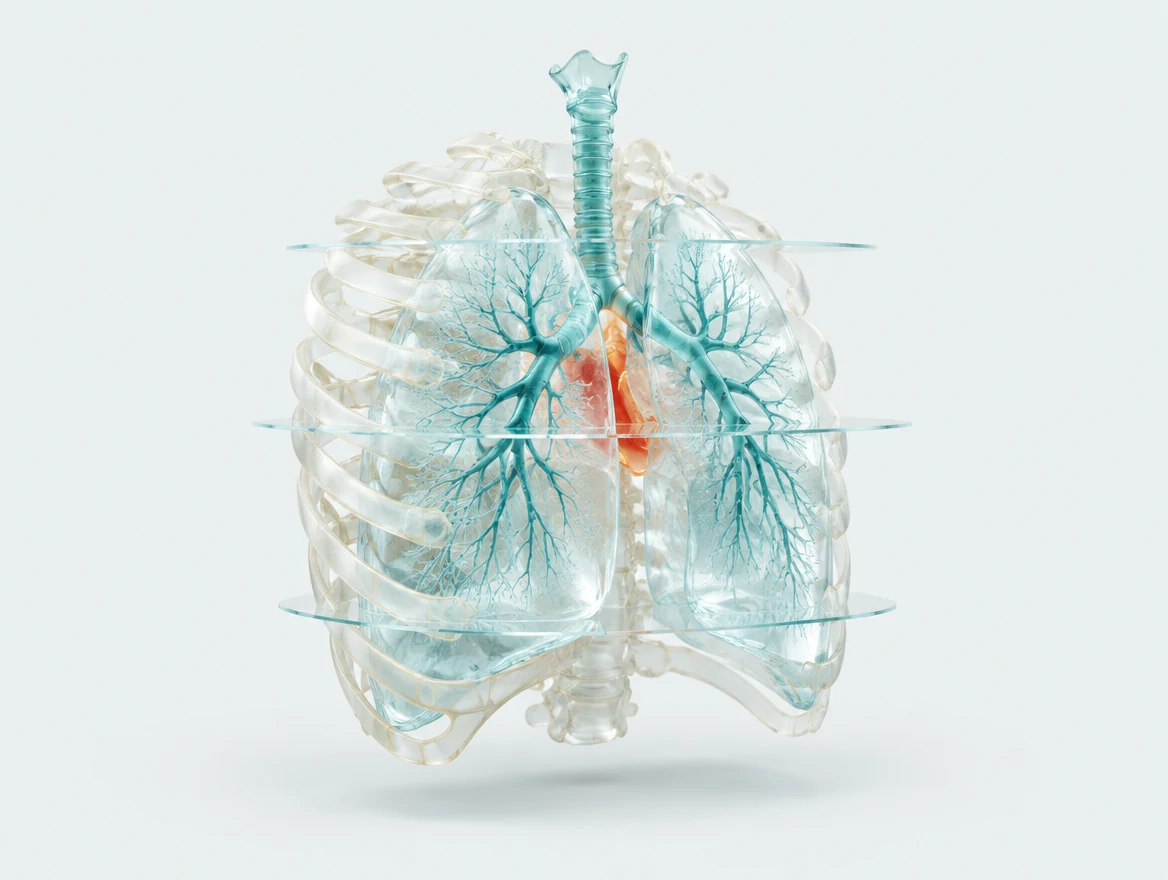 THORACIC ANATOMY CONCEPT ILLUSTRATION
An illustration of the workspace we’re developing, rather than a live software demo.
We’re designing the suite around local processing on your PC.
Compare the model with the images it came from.
Review edits, check warnings and keep a record of your work.
02 / ONE CONNECTED WORKFLOW
From opening a study to saving a model.
Choose a step to see what we’re working on.
Bring supported inputs into a local research project and check their orientation, spacing and source details before modelling.
Input compatibility is being evaluated. A supported example is not a guarantee for every study.
03 / OUR RECONSTRUCTION RESEARCH
Smoothing a model can remove useful detail or change the space between organs. We’re studying how to improve a surface while checking what changes elsewhere.
Where did it improve?
What else changed?
Check which details an edit preserves and which it changes.
Measure the gaps between neighbouring structures, as well as each model’s shape.
Record unsuccessful edits too. Once a method is fixed, test it on cases it has not seen before.
Showing all 6 capabilities.
Development status: 9 October 2026. Private Windows research preview; candidate AI and wider hardware support are still being evaluated. Not clinically validated or for clinical decisions. Read the development updates.
04 / BUILT WITH PEOPLE IN MIND
YOUR WORK
Moving from a scan to a reviewed model takes several steps. We want to make those handoffs easier to manage.
Tell us where you spend time repeating work, switching tools or checking an output.
Discuss your workflow05 / OUR PURPOSE
We want to give healthcare teams better ways to understand anatomy and work with it.
Wellbeing Technologies is a UK company developing desktop software for medical imaging and 3D modelling. Our focus is practical: bring the work into one place and make each model easier to inspect and review.
We’re still building. Alongside the software, we’re researching how reconstruction changes anatomical detail. We want the people who do this work every day to help shape what comes next.
BEFORE WE TALK
There is no public download yet. Our Windows installer is being tested privately. Get in touch to discuss your intended use and future evaluation opportunities.
No. This is research software and has not been clinically validated. It must not be used for diagnosis or treatment decisions.
The images and animation illustrate the product we’re developing. They are not patient scans, software screenshots or evidence of clinical accuracy.
The private preview brings image inspection, segmentation editing and model review into a Windows application. Local AI proposals and broader compatibility are still being tested. See our development updates for the current scope.
We’re designing the software to process scans on your computer. The current research version does not send scans to an external processing service. We’ll publish the final data-handling and security details before release.
We’re discussing research, education and institutional access before setting commercial prices. The customer portal is being prepared for accounts, licences, downloads and support; account registration is not open yet.
KEEP EXPLORING
Research · 4 MIN READ
A clean surface can look convincing. The harder question is what changed to get there.
Read articleProduct · 3 MIN READ
From opening a study to sharing a model, the handoffs deserve as much attention as the tools.
Read articleEvaluation · 4 MIN READ
A practical starting point for a useful technical conversation with your team.
Read articleTELL US ABOUT YOUR WORK
Tell us about the scans you work with, the models you need and where your current tools fall short.
Start a conversationPlease share project context, not patient information.